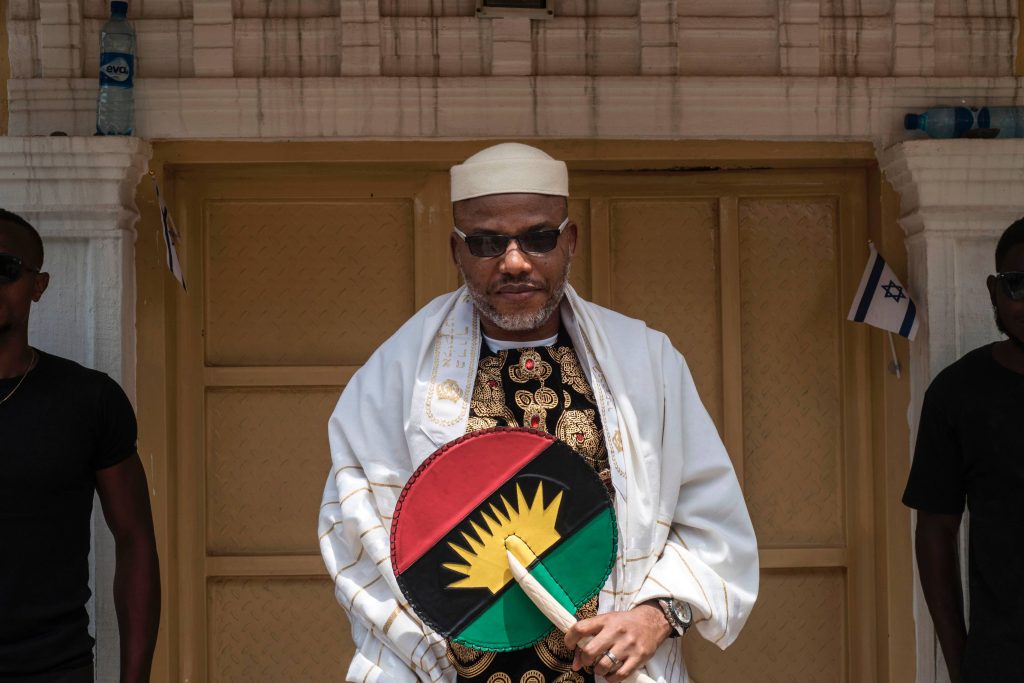
The Indigenous People of Biafra (IPOB) has highlighted what it described as some of the major achievements of its leader, Mazi Nnamdi Kanu, in his agitation for the restoration of Biafra.
In a lengthy memorandum addressed to IPOB members worldwide, the group’s spokesperson and Media and Publicity Secretary, Comrade Emma Powerful, argued that Kanu’s impact should not be measured by political office or government authority, but by his ability to mobilise ordinary people and influence national debates.
Powerful made the remarks while responding to questions about what tangible benefits Kanu’s agitation had brought to the people.
According to him, Kanu played a significant role in mobilising opposition to the Federal Government’s proposed RUGA settlement programme and the National Water Resources Bill.
He also credited the IPOB leader with drawing widespread attention to issues surrounding land ownership, territorial control, resource management and what the group described as a broader “Fulanisation agenda.”
IPOB Credits Kanu With Mobilising RUGA Opposition
Powerful argued that Kanu’s intervention during the RUGA controversy helped transform what was initially presented as a livestock settlement policy into a wider national debate about land and the rights of indigenous communities.
He said Kanu used Radio Biafra and his large grassroots following to raise concerns about the proposed settlements, particularly their potential implications for land ownership, population movement and territorial control.
According to the memo, Kanu raised questions about who would own and control the land and what could happen to indigenous populations if they lost control of their ancestral territories.
Powerful maintained that the campaign helped increase public awareness and pressure on political leaders to take a position on the controversial policy.
He noted that Kanu did not hold a government position, was not a governor or member of the National Assembly and had no statutory authority to stop the programme.
Instead, he argued that Kanu relied on grassroots mobilisation to influence the political environment surrounding the proposal.
‘He Made Resistance Politically Difficult’
The IPOB spokesperson further argued that Kanu’s influence changed the political calculations of leaders who might otherwise have preferred to quietly negotiate with the Federal Government.
According to him, political office holders became increasingly conscious of the views of their constituents and the potential consequences of supporting policies that were perceived by their communities as a threat to ancestral lands.
“His broadcasts created an atmosphere in which Southern political leaders knew that cooperation with a controversial land policy could have serious consequences at home,” the memo stated.
Powerful said governors, traditional rulers, lawmakers and communities were compelled to pay closer attention to the concerns being raised.
He maintained that Kanu’s role was not to exercise a legal veto over the RUGA programme, but to create sufficient public pressure for political leaders to resist it.
RUGA Programme Eventually Suspended
The memo acknowledged that Kanu was not the only individual or group involved in opposing RUGA.
Powerful credited Southern governors, Middle Belt communities, farmers, traditional institutions and political leaders who publicly resisted the proposal.
He specifically mentioned former Benue State Governor Samuel Ortom among those who opposed the policy.
However, the IPOB spokesperson insisted that Kanu’s contribution to the mobilisation effort should not be overlooked.
He argued that the controversy eventually spread beyond the South-East, becoming a broader national issue before the Federal Government suspended the RUGA programme.
Water Resources Bill Also Highlighted
IPOB also pointed to Kanu’s opposition to the National Water Resources Bill as another major issue in which it believed he made an impact.
According to Powerful, Kanu drew public attention to questions concerning control of rivers, waterways and riverbanks, as well as the implications of the proposed legislation for communities whose livelihoods depend on water resources.
The IPOB spokesperson said Kanu linked the water resources debate with the broader question of land and territorial control.
He argued that the campaign helped move the issue from a technical legislative discussion to a subject of wider political and public debate.
However, the memo itself acknowledges that the bill was not stopped by Kanu’s broadcasts alone.
Powerful noted that legislators, communities and other groups also opposed aspects of the proposed legislation.
He nevertheless maintained that Kanu helped mobilise grassroots opposition by making people more aware of the potential implications of legislation being considered in Abuja.
The bill ultimately failed to become law in the form proposed.
IPOB Highlights ‘Fulanisation Agenda’
Another issue highlighted by Powerful was Kanu’s use of the phrase “Fulanisation agenda.”
The IPOB spokesperson claimed that Kanu had popularised the expression before former President Olusegun Obasanjo later used similar terminology publicly.
According to the memo, the development was significant because language associated with Kanu’s warnings eventually entered mainstream political discussions.
Powerful argued that Kanu had succeeded in broadening public attention from individual policies to what IPOB viewed as a wider pattern involving land, population, political influence and control of resources.
‘It Was Not Just About Cattle’
The IPOB spokesperson said Kanu’s warnings about RUGA and related policies went beyond the issue of cattle or livestock settlements.
According to him, the IPOB leader was concerned about the combined implications of land acquisition, open grazing, population movement, water-resource control and political authority.
Powerful summarised the group’s position by arguing that communities that lose control of their land could eventually lose influence over their political and economic future.
He said the message resonated particularly strongly among Biafrans because of their interpretation of historical developments involving indigenous communities in parts of what later became the northern emirates and the Sokoto Caliphate.
Why IPOB Calls Kanu ‘Another Saviour’
Powerful also explained why some Biafrans describe Kanu as “another saviour.”
According to him, the expression reflects the belief among his supporters that Kanu identified threats to their communities before they received sufficient attention from political leaders and mainstream institutions.
He said Kanu’s supporters believe he raised the alarm over land, security and territorial issues and helped mobilise resistance before many political leaders became actively involved.
For that reason, Powerful argued that the description is rooted in what Kanu’s supporters believe he helped prevent rather than simply being an expression of political loyalty.
IPOB Lists Kanu’s Alleged Achievements
In the memorandum, Powerful listed several developments that he said demonstrated Kanu’s influence.
They included the mobilisation of opposition to RUGA, the campaign against the National Water Resources Bill, increased public awareness about land and territorial issues, and the emergence of greater resistance to what IPOB described as external threats to indigenous communities.
He also argued that Kanu helped strengthen the willingness of regional political leaders to challenge decisions originating from the Federal Government.
Powerful stressed that Kanu achieved these things without holding public office or controlling government resources.
“He had no government machinery. He had no public treasury. He had no official position,” the memo stated.
According to him, Kanu instead relied on his voice and his supporters to build a movement capable of exerting political pressure.
‘He Gave People the Courage to Demand Action’
The IPOB spokesperson argued that Kanu’s greatest impact was his ability to turn public concerns into organised grassroots pressure.
He said the IPOB leader encouraged people to question decisions being made by government authorities and demand accountability from their political representatives.
Powerful maintained that this mobilisation made it increasingly difficult for politicians to ignore public opposition to policies considered controversial by their constituents.
He described this as the central distinction between having formal political power and possessing the ability to mobilise public opinion.
IPOB Says Kanu’s Influence Went Beyond Biafra
Although Kanu’s primary political objective remains the restoration of Biafra, Powerful argued that his activities had consequences beyond the South-East.
According to him, concerns raised by Kanu about land, water resources, security and territorial control resonated with communities in Southern Nigeria and the Middle Belt.
He said the issues prompted more Nigerians to ask questions about the protection of their ancestral lands and the future of indigenous communities.
The IPOB spokesperson therefore argued that Kanu’s influence should be considered not only within the context of the Biafran struggle but also in relation to broader national debates.
‘His Achievement Was Grassroots Mobilisation’
Powerful concluded that Kanu’s achievements should not be assessed solely by conventional political standards.
He argued that while some people measure political success by positions held, laws passed or government resources controlled, revolutionary movements often measure success by the ability to awaken political consciousness and mobilise people.
According to him, Kanu succeeded in building a global communication network, developing a significant grassroots following and bringing the Biafran self-determination campaign into international discussions.
He also credited him with helping to galvanise opposition to RUGA and the proposed Water Resources Bill, while increasing public discussion around land, indigenous rights and territorial security.
“HE SAW THE DANGER. HE SOUNDED THE ALARM. HE MOBILISED THE PEOPLE,” Powerful said in the memo.
He maintained that Kanu’s influence came from his ability to inspire people to demand action from those in positions of political authority.
The IPOB spokesperson concluded by insisting that Kanu’s legacy should be viewed through the impact of his activism and mobilisation rather than the absence of a formal government position.