Rescue teams in Nepal have successfully pulled two workers alive from a hydropower tunnel, nine days after devastating floods swept through parts of the country and left hundreds of workers missing.
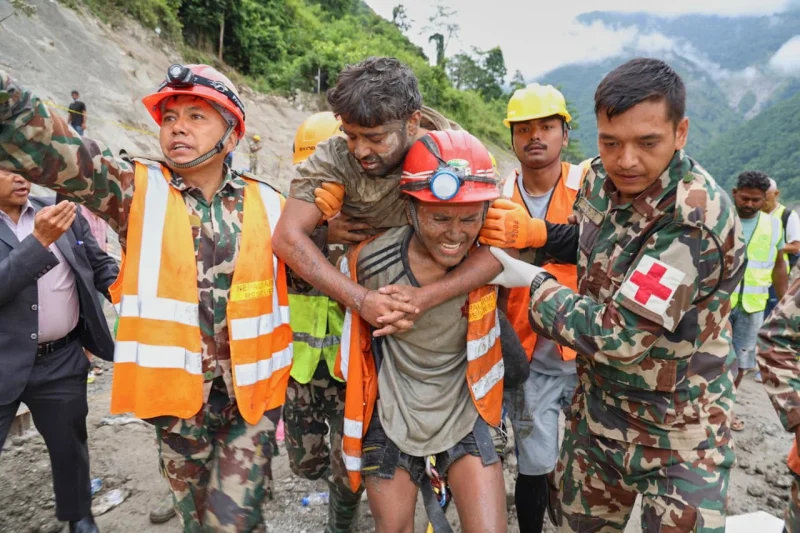
The two men were rescued on Friday from the Trishuli 3A hydropower project, where emergency personnel have been working around the clock to locate and evacuate people believed to be trapped inside the underground tunnel system.
The rescue operation follows catastrophic flooding that struck the area on August 26. The floods, which were reportedly linked to a glacier collapse, caused widespread destruction, damaging towns, sweeping away villages and leaving a large number of people unaccounted for.
The first successful rescue was confirmed by Nepalese Army spokesperson Brig. Gen. Raja Ram Basnet, while Nepalese lawmaker Shri Ram Neupane later announced that a second worker had also been brought out alive.
Authorities identified the rescued men as a mechanical foreman and a mechanical supervisor working at the hydropower facility.
Television footage from the scene showed the first rescued worker being carried away by a member of the rescue team. The man was visibly covered in mud after spending more than a week underground.
Despite the difficult conditions in which they were found, both workers were reportedly in stable condition following their rescue.
The rescued men were subsequently flown to a hospital in Kathmandu for medical evaluation and treatment.
The successful rescue has offered a measure of hope to families still waiting for news of their relatives who remain missing following the disaster.
According to figures provided by the Independent Power Producers Association of Nepal, at least 557 workers connected to the Trishuli 3A hydropower project are still missing.
Of that number, approximately 115 people are believed to remain trapped inside the main tunnel, raising fears that the rescue operation could become increasingly difficult as emergency crews attempt to reach deeper sections of the facility.
Rescue teams have continued efforts to clear debris and navigate the damaged tunnel in search of survivors. The operation has been complicated by the scale of the flooding and destruction caused by the disaster.
The Trishuli River, along which the hydropower project is located, was heavily affected by the floods. The disaster caused extensive damage in surrounding communities, with powerful floodwaters carrying away structures and leaving large areas devastated.
The reported connection between the flooding and a possible glacier collapse has also highlighted the risks posed by sudden glacial events in mountainous regions of Nepal.
For relatives of those still missing, the rescue of the two workers has renewed hopes that more people could be found alive despite the passage of several days since the disaster.
Rescue officials are expected to continue searching the tunnel and other affected areas as efforts intensify to locate those still unaccounted for.
The two successful rescues demonstrate that survival remains possible even after prolonged periods underground, while the ongoing operation remains focused on reaching the workers believed to be trapped inside the main tunnel.
Authorities have yet to provide a final account of the full scale of casualties from the August 26 disaster, as rescue and recovery operations remain underway.