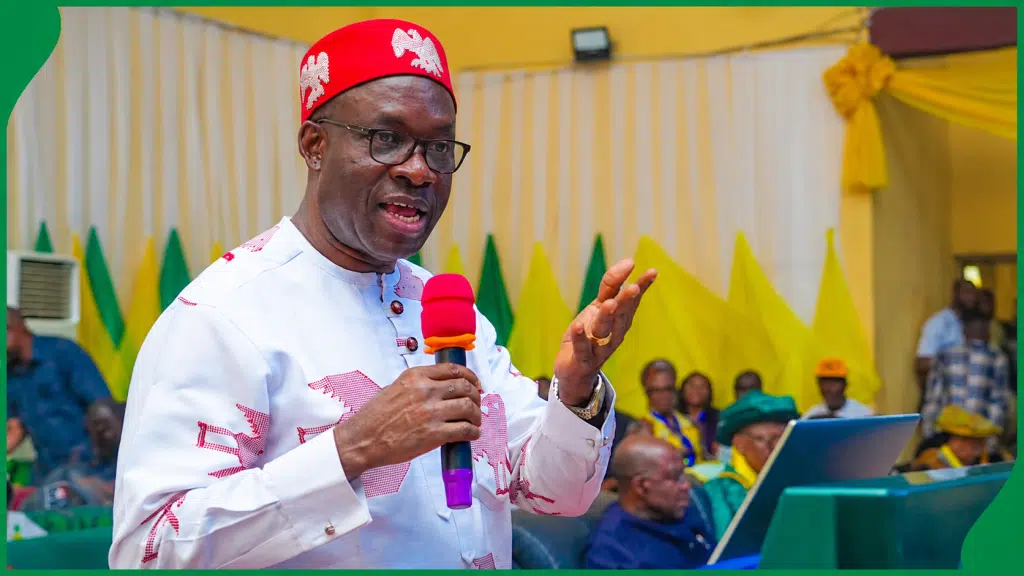
Anambra State Governor, Charles Soludo, has revealed that the Economic and Financial Crimes Commission (EFCC) investigated him after his tenure as Governor of the Central Bank of Nigeria (CBN).
Soludo disclosed that he was invited by the anti-graft agency for questioning over the activities of the Nigeria Security Printing and Minting Plc, where he served as chairman of the board.
The governor, however, said the investigation did not establish any wrongdoing against him and that the EFCC subsequently communicated his clearance to him.
Soludo spoke on Friday while commissioning the EFCC Awka Zonal Directorate Complex, which will oversee the commission’s operations in Anambra and Imo states.
Recounting his experience, the governor said he received a one-month notice from the EFCC regarding the investigation and appeared before the commission as requested.
According to him, after appearing before the agency, he did not hear from the EFCC for about a year.
He said he subsequently wrote to the commission seeking an update and was informed that the investigation had not established any corrupt conduct on his part.
Soludo said:
“My personal testimonies about the professionalism of this Commission is that when I left office as CBN Governor, EFCC was investigating Nigeria Printing and Minting Company, the Mint, an agency within the bank.
“I was chairman of board of the Mint and was given one month notice of investigation and I showed up. After about a year, I didn’t hear from them, so I wrote them and they said that the investigation didn’t show any corrupt action about me.”
The Anambra governor further explained that the then EFCC chairman had clarified that he was not the subject of the investigation after his name was mentioned in connection with the matter.
He said the commission later wrote to him formally, confirming that its investigation had not established any wrongdoing on his part.
Soludo added:
“When my name was mentioned in connection with the investigation, the former chairman of EFCC told them that I was not the subject of the investigation.
“Subsequently, the Commission wrote me a beautiful letter and said the investigation showed I didn’t have anything to do with the matter.”
The governor said the experience strengthened his appreciation of the EFCC’s professionalism and urged the commission to formally notify individuals invited for questioning when investigations eventually establish that they were not culpable.
He noted that in Nigeria, being invited by an anti-corruption agency is often reported as though the individual has already been found guilty.
“So I deeply appreciate the professionalism of the Commission. I want to urge that if you invite someone and later fail to find him complicit, you must write and say so, especially in this part of the world where, if you invite people, it finds its way into the pages of newspapers because they see invitation as an indictment,” Soludo said.