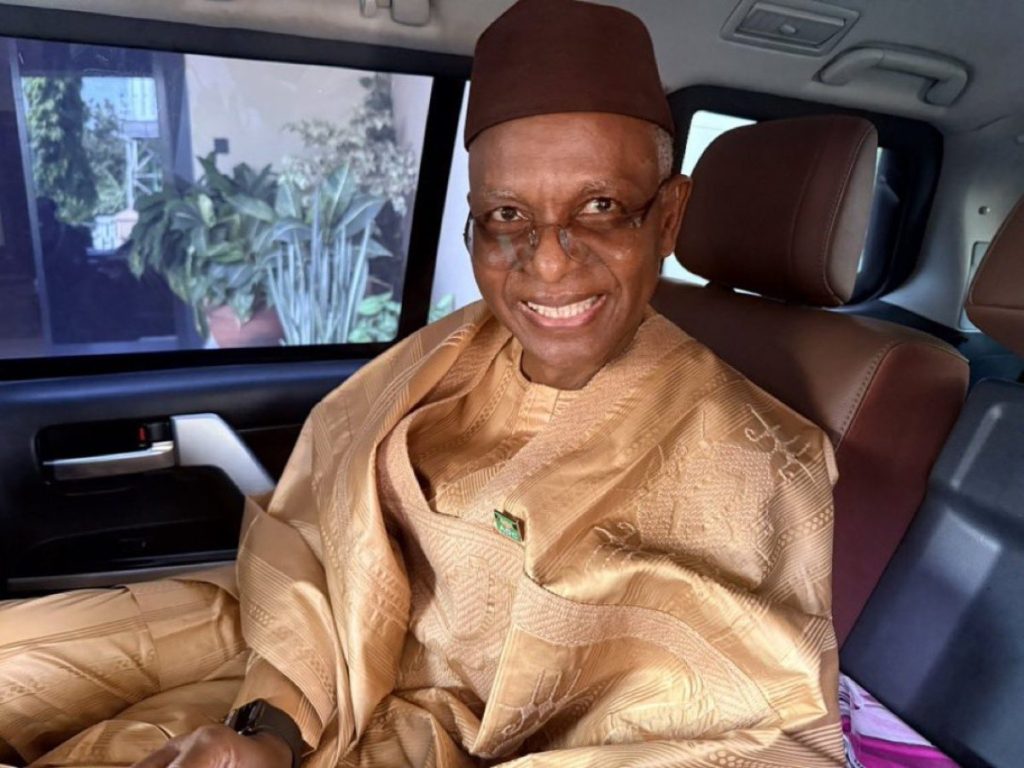
Tension flared outside a court in Kaduna on Wednesday after security operatives prevented Senator Lawal Adamu Usman from entering a vehicle conveying former Kaduna State governor, Nasir El-Rufai, following court proceedings.
The lawmaker, who recently defected from the All Progressives Congress (APC) to the African Democratic Congress (ADC), was captured in a viral video attempting to join El-Rufai inside a black SUV stationed within the court premises.
In the footage, heavily armed operatives of the Department of State Services (DSS), some dressed in tactical gear and helmets, were seen controlling a crowd of journalists, supporters, and onlookers.
As the SUV door opened, Senator Usman moved toward the vehicle alongside El-Rufai but was abruptly stopped by DSS officials, who blocked his access. In the heated moment, one of the operatives was heard saying, “He’s a senator, and so what?”—a remark that has since triggered reactions online.
El-Rufai Speaks on Nigeria’s Economy
Amid the courtroom drama, El-Rufai also weighed in on Nigeria’s economic challenges in a statement shared via his Facebook page the same day.
According to the former governor, Nigeria’s economic struggles are not due to a lack of talent, capital, or ideas, but rather how the country’s most capable individuals are deployed.
“Nigeria’s growth problem is not primarily a shortage of talent, capital, or ideas. It is a problem of where our best talent goes, and why,” he stated.
He argued that many skilled Nigerians are drawn toward sectors that offer quick financial returns, particularly in systems where minor skill advantages can yield disproportionately high rewards.
“People do not wake up intending to harm their country. They respond rationally to incentives,” El-Rufai added, noting that the current system tends to reward rent-seeking over productive enterprise.
Key Economic Concerns
El-Rufai backed his claims with data, highlighting that:
- Nigeria’s GDP growth stood at about 4.1% in 2024
- GDP per capita remains around $1,084
- Informal employment accounts for roughly 93% of the labour force
- Tax-to-GDP ratio is approximately 8.2%
“These numbers are not abstract,” he said. “They reflect an economy where scaling a business is risky, and visibility often attracts undue pressure.”
He warned that when top talent migrates away from productive sectors, innovation slows, entrepreneurship weakens, and long-term economic growth declines.
Path to Recovery
Despite the concerns, El-Rufai pointed to signs of potential growth, especially in non-oil exports such as cocoa, fertiliser, cashew, and processed agricultural goods.
He emphasized that aligning incentives correctly could unlock Nigeria’s economic potential, proposing reforms such as:
- Reducing discretionary government powers
- Ensuring predictable and digital regulations
- Strengthening property rights
- Creating an enabling environment for businesses to scale
“Nigeria’s future does not hinge on slogans or personalities,” he concluded. “It depends on who the system rewards. If producers are prioritised over extractors, growth will come rapidly and sustainably.”