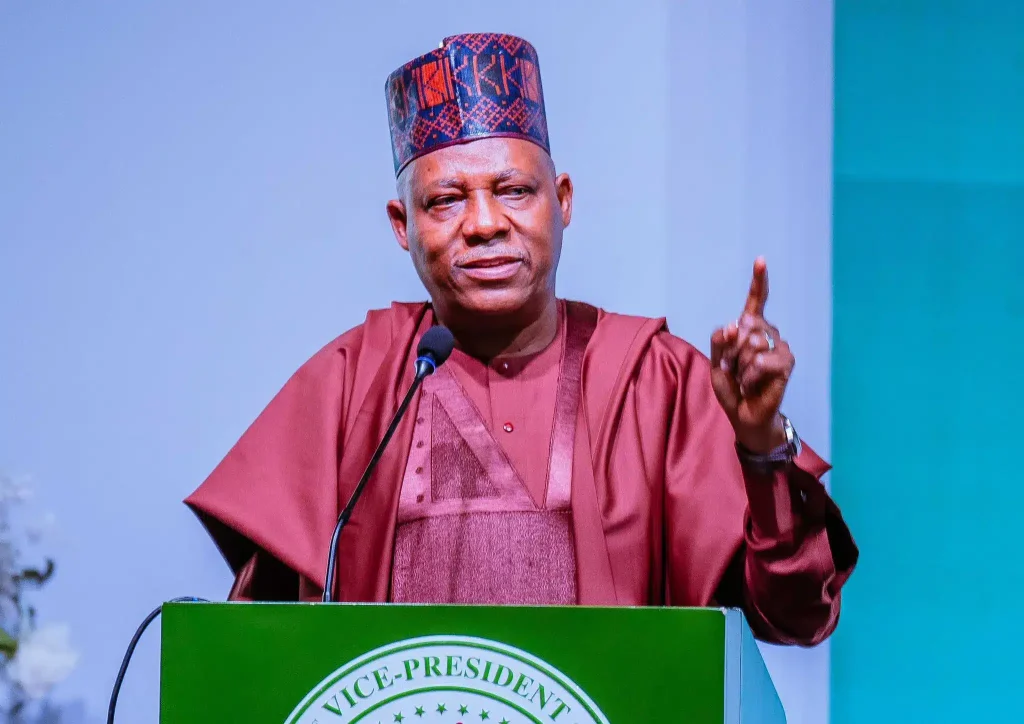
Vice President Kashim Shettima has revealed that the controversial removal of fuel subsidy by President Bola Ahmed Tinubu during his inauguration at Eagle Square on May 29, 2023, was a spontaneous and decisive move that was not originally included in the official speech.
The announcement, which immediately altered Nigeria’s fuel pricing structure, marked a turning point in the country’s economic policy and triggered widespread reactions due to its ripple effects on transportation costs, inflation, and overall cost of living.
Speaking at the Nasarawa Economic Summit 2026 as the special guest of honour, Shettima defended the decision, describing it as both bold and necessary. According to him, the Tinubu administration inherited a fragile economy with severely depleted reserves, leaving little room for delay or hesitation.
He explained that the government was faced with stark realities upon assuming office, including limited financial capacity to sustain the long-standing subsidy regime. In his words, the country’s reserves at the time were insufficient to cover even a month’s fuel imports, making the continuation of subsidy payments unsustainable.
Shettima noted that although the administration was aware of the political and social implications of such a move, it opted for transparency and decisive action rather than postponing an inevitable reform. He added that the President deliberately avoided publicly highlighting the severity of the country’s financial situation to prevent panic and further economic instability.
Highlighting the impact of the reforms, the Vice President argued that Nigeria is now beginning to see positive outcomes. He pointed to improving investor confidence, recovery in external reserves, and notable gains in the capital market as indicators that the country is gradually stabilising.
According to him, Nigeria’s gross external reserves rose above $46 billion in 2025 and have continued on an upward trajectory. He also cited significant appreciation in banking stocks such as Zenith Bank and Guaranty Trust Bank, noting that share prices have climbed substantially compared to the previous year—an indication, he said, of renewed market confidence.
Shettima emphasised that investors are increasingly viewing Nigeria as a country willing to confront its economic challenges head-on. He stressed that credibility, consistency, and clear policy direction are key factors attracting both local and foreign investments.
His remarks came on the heels of comments by President Tinubu during an engagement with foreign investors in Paris, France, where he stated that the removal of fuel subsidy has contributed to stabilising Nigeria’s foreign exchange market. According to the President, eliminating the subsidy lifted a major fiscal burden and created room for broader economic reforms.
Further reinforcing the administration’s stance, presidential spokesman Bayo Onanuga said the government’s reform agenda is focused on eliminating structural distortions, strengthening macroeconomic stability, and laying the groundwork for inclusive growth. He added that the administration has prioritised fiscal discipline, transparency, and swift policy implementation.
Similarly, the Minister of Finance and Coordinating Minister of the Economy, Taiwo Oyedele, reiterated that there are no plans to reinstate fuel subsidy despite public pressure. He argued that subsidy payments historically distorted the market and placed undue strain on public finances, maintaining that fuel pricing should be determined by market forces rather than government control.
The removal of fuel subsidy remains one of the most debated decisions of the current administration. While government officials continue to defend it as a necessary step toward economic recovery and sustainability, many Nigerians still grapple with its immediate consequences, including rising transport fares, increased food prices, and higher household expenses.