The South African government has arrested 364 people in connection with attacks on African migrants, as the country’s diplomatic mission in Nigeria rejects claims that South Africa is xenophobic.
The Acting Consul-General of South Africa in Lagos, Kgothatso Xulu, disclosed this on Tuesday while speaking at the 47th Annual Conference of the Nigerian Society of International Law (NSIL), held at the Nigerian Institute of International Affairs in Victoria Island, Lagos.
Xulu said the attacks should not be used to characterise the entire country or its citizens as hostile to foreigners, insisting that the South African government and its people strongly condemn xenophobia.
“I wouldn’t be doing my country any justice if I don’t actually address and defend that South Africa is not xenophobic and we reject, we completely reject what is happening,” she said.
The diplomat argued that the actions of a small group of individuals should not define the entire nation, describing xenophobia as a broader challenge affecting countries across the continent.
“But we cannot be generalized with small pockets that are using the opportunity, which is a global problem that is affecting the continent,” she added.
The conference was held under the theme, “From Obligation to Implementation: Reassessing the Efficacy of International Law in Contemporary International Relations.”
Xulu Urges African Countries to Address Causes of Migration
The South African diplomat acknowledged that irregular migration and poor service delivery remained challenges in her country. However, she urged African governments to examine the economic conditions forcing many citizens to leave their home countries.
According to her, migration across African borders should increasingly be driven by trade, investment and business expansion rather than economic hardship and the struggle to survive.
Xulu questioned why many Africans had to leave their countries out of desperation instead of moving across borders to explore business opportunities and develop new markets.
“If we want to really have an Africa that we see viable, it has to be that our people are not leaving our homes because of economic emancipation, but rather we are leaving our homes to say that I would like to trade, I would like to extend our market,” she said.
She linked the issue to the African Continental Free Trade Area (AfCFTA), which aims to expand trade among African countries and establish a single continental market for goods and services.
Xulu maintained that trade should be used to create wealth, strengthen businesses and expand economic opportunities across the continent rather than serve primarily as an escape from poverty.
“Trade shouldn’t be about survival, but trade should be about we are creating a market,” she said.
Diplomat Defends Peaceful Protests
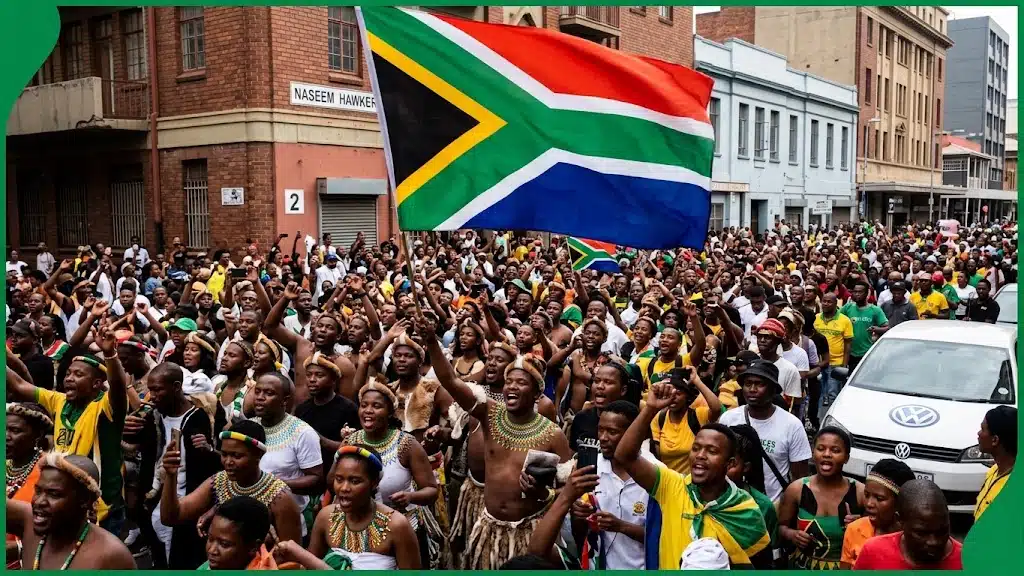
Xulu also defended South Africa’s constitutional protection of peaceful protests, noting that demonstrations played a significant role in the country’s struggle against apartheid.
She said peaceful demonstrations should not automatically be regarded as violent simply because they attract large crowds or generate public attention.
“The Constitution says peaceful protests for South Africans are allowed. This is how we were partly able to win and be able to push the apartheid government, because our people protested,” she stated.
She explained that procedures existed for organising protests and that the police had a responsibility to protect demonstrators and other members of the public.
The diplomat further urged observers to consider South Africa’s history, noting that the country had spent about 30 years under democratic rule.
Xulu Warns Against Misinformation
The South African representative criticised the tendency to use isolated incidents to form broad judgments about an entire country, warning that misinformation and fake news could deepen tensions between African nations.
She said inaccurate media reports risked creating misleading impressions about South Africans and undermining efforts to strengthen relationships among African countries.
To illustrate South Africa’s historical ties with the continent, Xulu referenced its national anthem, which begins with a prayer for God’s blessings upon Africa.
She said the anthem reflected the country’s recognition of the support it received from other African nations during the struggle against apartheid.
Calls on Nigeria to Lead Continental Dialogue
Xulu called for platforms where African countries could engage in structured and honest discussions on migration, xenophobia and economic cooperation.
She urged Nigeria to take the lead in facilitating such conversations at the next meeting of the Nigerian Society of International Law.
According to her, African governments must work together to address the underlying causes of migration and other challenges affecting the continent.
The diplomat also called on African countries to participate more actively in discussions on international law and global governance, arguing that greater involvement would enable them to influence decisions affecting their interests.
“Entering into the space of international rules means that Africans are able to make decisions for themselves,” she said.
Xulu expressed appreciation for the conference’s discussions on international law and South Africa’s role at the International Court of Justice.
She concluded by urging young Africans to take greater responsibility for shaping the continent’s future.