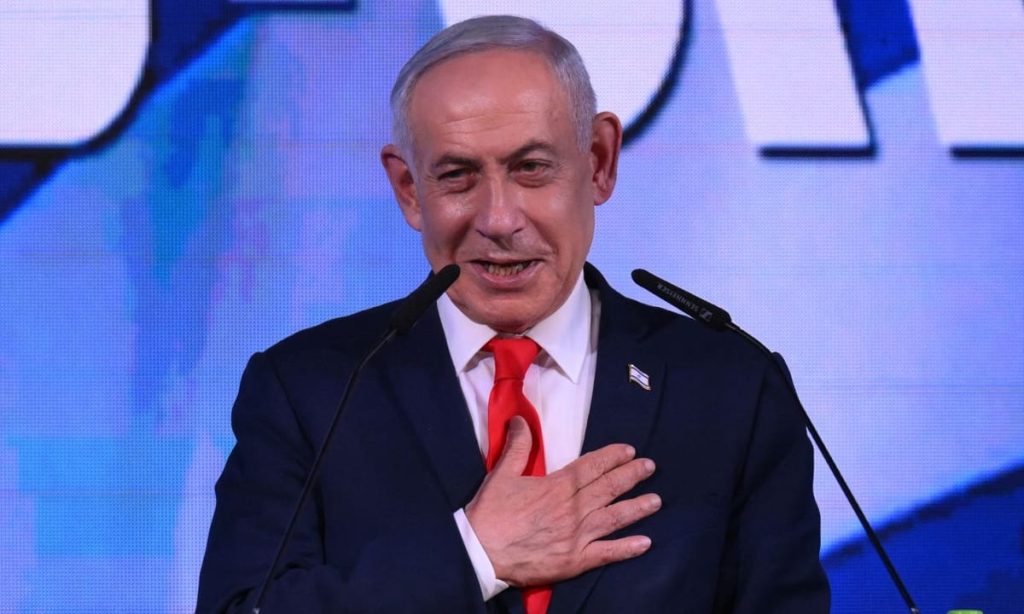
Israel’s latest general election has ended in a hung parliament, with neither Prime Minister Benjamin Netanyahu’s political bloc nor the opposition alliance led by Gadi Eisenkot winning enough seats to form a government independently.
Final results released by election officials showed that Netanyahu’s right-wing bloc secured 53 seats in the 120-member Knesset, while the alliance backing Eisenkot won 48 seats. Both blocs remain short of the 61 seats required for a parliamentary majority.
The outcome marks a setback for Netanyahu, whose political bloc controlled as many as 68 seats at its peak during the outgoing parliament.
One of the major developments from the election was the strong showing by parties representing Israel’s Arab minority. The parties collectively won 19 seats following what was described as a record turnout among Palestinian citizens of Israel.
The performance of Arab-led parties, particularly Ra’am and the Joint List, could give them significant influence in the negotiations to form the next government. However, both Netanyahu’s bloc and the main opposition alliance have ruled out forming a coalition with the Arab parties.
The election results have also renewed focus on the role of Palestinian citizens of Israel, many of whom reportedly turned out to vote in hopes of ending Netanyahu’s rule and removing far-right figures from his outgoing coalition, including Finance Minister Bezalel Smotrich and National Security Minister Itamar Ben-Gvir.
Meanwhile, Yair Golan, leader of the smaller left-wing Democrats party, called for the inclusion of Arab parties in the next government.
In a post on X, Golan accused Netanyahu of attempting to divide the electorate along ethnic lines and argued that Arab citizens should not be excluded from Israel’s political process.
The election campaign was also overshadowed by allegations of foreign interference. Netanyahu and members of his coalition raised concerns about alleged Qatari involvement and called for Arab parties to be investigated by Israel’s domestic security agency, Shin Bet.
Qatar denied the allegations, while Ra’am leader Mansour Abbas rejected claims of any involvement and called for a thorough investigation. Abbas also accused Netanyahu of using incitement and attempting to delegitimise Arab citizens during the campaign.
Dean Livne, acting director-general of Israel’s Central Elections Committee, said there was no evidence to support allegations of widespread electoral misconduct.
Although ballot counting has been completed, the results must still undergo formal certification before being submitted to President Isaac Herzog.
Herzog is expected to hold consultations with political party leaders before assigning the mandate to the candidate he believes has the best chance of forming a governing coalition.
The outcome leaves Israel facing a fresh period of political uncertainty, as negotiations and potential alliances will determine whether Netanyahu can retain power or whether the opposition can put together an alternative government.