A legal practitioner, Christopher Chidera, has raised fresh questions about the conviction of the detained leader of the Indigenous People of Biafra (IPOB), Mazi Nnamdi Kanu, arguing that the judgment delivered by Justice James Omotosho on November 20, 2025, was fundamentally defective because the trial court failed to comply with mandatory provisions of the Terrorism Prevention and Prohibition Act (TPPA) 2022.
In a public briefing note dated November 2, 2026, Chidera maintained that the trial court proceeded with Kanu’s trial under the Terrorism Prevention (Amendment) Act 2013, despite the enactment of the 2022 legislation, which repealed and replaced the earlier law.
The lawyer argued that Sections 97 and 98(2) of the 2022 Act imposed a mandatory obligation on the court to transition the proceedings to the new legal framework.
He described the failure to comply with these statutory provisions as a fundamental legal defect that undermined the foundation of the conviction.
According to Chidera, the central issue is not simply whether the trial court made an error in interpreting the law, but whether it had a valid legal basis to proceed with the charges and ultimately convict Kanu under a repealed statute.
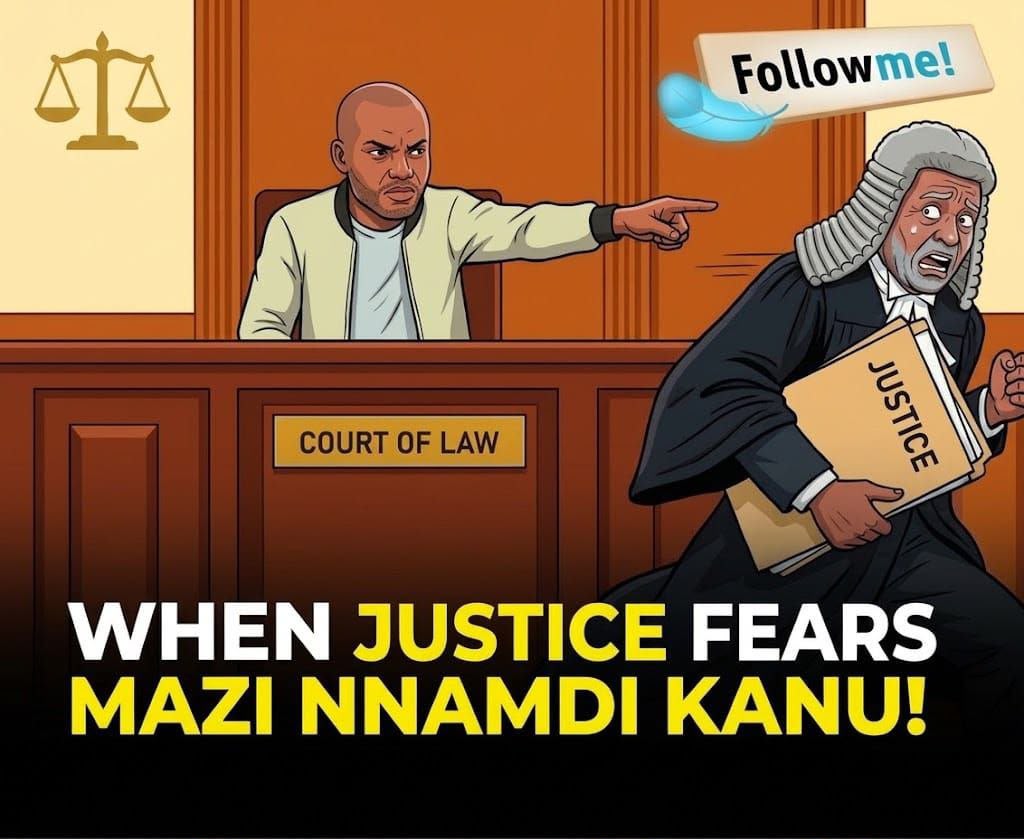
Chidera’s briefing revisited Kanu’s courtroom confrontation with Justice Omotosho, particularly the proceedings of November 4, 2025, when the IPOB leader personally challenged the legal foundation of his trial.
According to the lawyer, Kanu, who had taken control of his defence and represented himself pro se, invoked Section 36(12) of the 1999 Constitution, which provides that no person shall be convicted of a criminal offence unless the offence and its penalty are prescribed in a written law.
Kanu reportedly argued before the court that the proceedings could not validly continue under a repealed law and urged the judge to terminate the trial on the grounds that the charges were not supported by an applicable written law.
Chidera stated that Justice Omotosho responded by acknowledging the constitutional principle, declaring that a person could not be convicted without a written law prescribing the offence.
The lawyer, however, argued that the judge subsequently proceeded with the trial and delivered a conviction without resolving the statutory issues raised by Kanu.
He described the exchange as a significant moment in the proceedings, maintaining that the court’s acknowledgment of the constitutional requirement made its subsequent handling of the case particularly problematic.
In the briefing, Chidera explained that Kanu’s decision to represent himself was part of a deliberate legal strategy aimed at challenging the jurisdictional and statutory foundation of the proceedings.
He said Kanu spent considerable time studying the relevant legislation while detained at a Department of State Services (DSS) facility before raising objections concerning the applicability of the 2013 terrorism legislation.
According to the lawyer, Kanu understood that Section 36(12) of the Constitution provided an important constitutional safeguard against criminal convictions based on offences not prescribed by an applicable written law.
Chidera also drew attention to the distinction between Sections 97, 98(2) and 98(3) of the Terrorism Prevention and Prohibition Act 2022.
He argued that while Section 98(3) served as a savings provision to preserve existing proceedings, Sections 97 and 98(2) imposed mandatory requirements concerning the transition to the new legislation.
The lawyer emphasised that the use of the word “shall” in the relevant provisions demonstrated that compliance was compulsory rather than optional.
He maintained that the trial court could not simply disregard those provisions and continue proceedings as though the 2013 legislation remained the applicable statutory framework.
The lawyer strongly criticised Justice Omotosho’s handling of the statutory objections, arguing that the judge failed to give proper consideration to the relevant provisions of the 2022 legislation.
He maintained that a court handling a criminal trial must be guided by the applicable statutes, constitutional requirements and binding decisions of superior courts rather than personal opinions or predetermined conclusions.
Chidera further argued that the failure to address the transition from the 2013 Act to the 2022 Act raised serious questions about the legal foundation of the proceedings.
He described the November 20, 2025 judgment as a self-defeating judicial decision, insisting that the trial court’s approach created a substantial legal vulnerability that could be examined by the appellate court.
The lawyer also questioned whether the trial court properly considered the constitutional implications of proceeding under legislation that had been repealed and replaced.
Chidera devoted another section of his briefing to the implications of the statutory arguments for the ongoing appeal.
He argued that the prosecution would face a difficult legal task defending a conviction if the appellate court accepted that the trial court failed to comply with mandatory transitional provisions of the 2022 Act.
According to him, the central challenge is how the prosecution can justify a conviction when the legal framework under which the proceedings were conducted is being questioned on constitutional and statutory grounds.
He also maintained that the appellate court would have to examine the official trial record, including the objections raised by Kanu and the court’s responses.
Chidera argued that the appellate court could not simply overlook a fundamental issue concerning the applicable law or treat compliance with mandatory statutory provisions as an insignificant procedural matter.
He further questioned the delay surrounding the appeal, suggesting that the legal issues raised by Kanu had created a difficult situation for the prosecution.
However, the briefing did not establish that the prosecution had formally abandoned its defence of the conviction or that the appeal had been deliberately delayed.
In his conclusion, Chidera described Justice Omotosho’s November 20, 2025 judgment as an unconstitutional nullity, insisting that the failure to comply with the applicable provisions of the Terrorism Prevention and Prohibition Act 2022 rendered the conviction legally unsustainable.
He argued that the matter goes beyond the courtroom disagreement between Kanu and the trial judge, describing it as a fundamental test of constitutional supremacy, statutory interpretation and judicial accountability.
The lawyer maintained that the judiciary must eventually confront the legal questions raised by the appeal rather than allow the controversy to remain unresolved.
He further argued that Kanu should be released unconditionally if the conviction cannot withstand the applicable constitutional and statutory requirements.
At the centre of Chidera’s briefing is a fundamental question: Can a person validly be convicted in a criminal trial without the court first resolving whether the legislation supporting the charges remained applicable after the enactment of a replacement law?
The issue places particular emphasis on Section 36(12) of the 1999 Constitution and the transitional provisions of the Terrorism Prevention and Prohibition Act 2022.
For Chidera, the answer is clear: the trial court had a mandatory duty to comply with the new legislation, and its failure to do so fatally undermined the conviction.
The final determination of these arguments rests with the appellate court, which will have to consider the relevant statutory provisions, constitutional safeguards, trial record and submissions of the parties.
The controversy surrounding Kanu’s conviction therefore continues to raise important questions about the application of criminal laws, the limits of judicial discretion and the responsibility of Nigerian courts to uphold constitutional requirements.