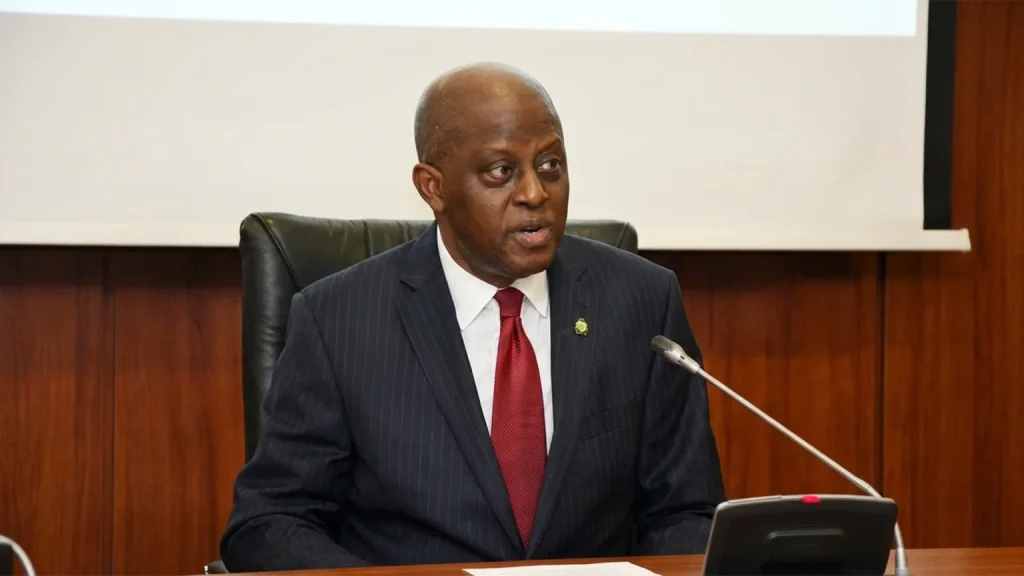
The Central Bank of Nigeria, on Thursday, warned Nigerians that failing to refund wrongly deposited money to the rightful owner attracts 5-10 years’ imprisonment, and cautioned bank customers against sharing their personal details with fraudsters.
The CBN Governor, Olayemi Cardoso, who explained that the act falls under financial crimes that attract severe punishment, gave the warning during the stakeholders’ meeting themed, “Central Bank of Nigeria Listens Programme,” held at Jogor Event Centre, Ibadan, Oyo State.
Cardoso, who spoke through Hakama Sidi Ali, said the CBN was committed to financial stability and the protection of customers’ rights.
He said, “Obtaining information relating to another person(s) account through fraudulent means attracts severe penalties. A customer who fails to refund wrongly deposited money to the rightful owner attracts 5-10 years’ imprisonment.
“The CBN Listens Programme is one of our flagship platforms for direct interaction with stakeholders across the country. It reflects our conviction that effective policy formulation and implementation must be supported by continuous dialogue and mutual understanding, and constructive feedback from the people and institutions we serve.
“The theme, ‘Towards a Robust, Resilient and Inclusive Financial System for Sustainable Economic Growth,’ is both timely and significant as Nigeria continues to navigate a rapidly evolving economy and financial landscape. The CBN remains steadfast in its mandate of ensuring monetary and financial system stability while promoting confidence in the economy.”
“Recent years have witnessed significant reforms aimed at restoring macroeconomic stability, strengthening financial markets, enhancing transparency, deepening financial inclusion and positioning Nigeria for sustainable growth. These priorities align with the bank’s strategic objectives of promoting a robust, sound and inclusive financial system that leverages innovation to enhance Nigeria’s competitiveness.
“To achieve these objectives, the bank has undertaken far-reaching reforms designed to strengthen the resilience and integrity of the Nigerian financial system. Over the past 38 months, the governor has pursued bold and pragmatic reforms to lay the foundation for Nigeria’s next economic phase, promoting inclusive growth and wealth creation to alleviate poverty.”
He added, “The launch of the non-resident BVN to connect Nigerians in the diaspora with local banking services, the system of forex trading, the unveiling of the Nigerian Payments System Vision 2028, and the implementation of the 75 per cent cash reserve ratio on non-treasury single account public sector deposits are intended to improve liquidity management and mitigate risk.
“The Nigerian Overnight Financial Rate was also introduced by the bank in collaboration with the Financial Market Dealers Association, among other initiatives. This benchmark, which aligns Nigeria’s monetary market infrastructure with international practices, provides a transparent market-based reference rate for short-term lending transactions.
“The CBN firmly believes that economic growth cannot be sustainable unless it is inclusive. Therefore, financial inclusion remains a critical pillar of national development. It expands economic opportunities, reduces poverty, supports entrepreneurship and promotes shared prosperity.
“We, therefore, continue to work closely with financial institutions, fintech companies, mobile money operators, development partners and state governments to expand and extend financial services to underserved populations of Nigerians.”
The CBN governor stressed that the bank’s Listens Programme was rooted in the recognition that stakeholders were partners in the development and implementation of effective policies.
He said, “The programme, therefore, provides opportunities for us to further explain policies, clarify misconceptions where they exist, receive feedback and identify issues affecting individuals, businesses and communities.
“As depositors, you have the right to escalate your complaint to the Director, Consumer Protection and Financial Inclusion Department, after lodging your complaint, if your bank fails to acknowledge it within three days.
“In the alternative, you can issue a tracking number if the bank fails to resolve the complaint within the timelines as stipulated by the Consumer Protection Regulation.”
It will be recalled that the CBN was established by the Central Bank Act of 1958 and officially commenced operations on July 1, 1959, in Lagos, taking over control from the British colonial West African Currency Board.