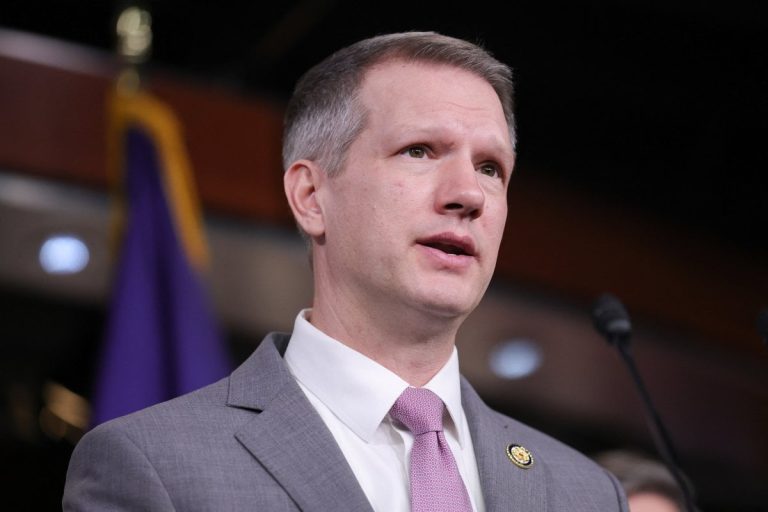
A member of the United States House of Representatives, Riley Moore, has called on the Nigerian government to grant clemency to Sunday Jackson, a farmer currently on death row for the killing of a herdsman during a violent encounter in Adamawa State in 2015.
Moore made the appeal on Thursday during a U.S. Congressional hearing reviewing President Donald Trump’s decision to redesignate Nigeria as a Country of Particular Concern (CPC) over alleged religious freedom violations. The lawmaker described Jackson’s conviction as deeply troubling and argued that the farmer acted in self-defence.
According to Moore, “I would urge the Nigerian government to take a look at pardoning Sunday Jackson, who is an individual who was fighting for his own life. That Fulani militant lost his life in that struggle, and now that person, Sunday Jackson, is facing the death penalty. Where is the justice in that?”
Concerns Over Armed Groups in the Middle Belt
Moore also used the hearing to highlight ongoing insecurity and the activities of armed groups, particularly in the Middle Belt region. He criticised what he described as the Nigerian government’s failure to curb the operations of heavily armed militants responsible for repeated attacks on farming communities.
He said, “Somehow, these Fulani militants operating in the Middle Belt region of the country are all armed. Why hasn’t there been a move or campaign by the Nigerian government to disarm these militants? We’re seeing a lot of killings coming from them. They have access to AK-47 rifles and other weapons used to slaughter Christians. Is this something you’ve been discussing with the Nigerian government? Because addressing this would have a serious impact.”
Background: Jackson’s Death Sentence and Legal Battle
Sunday Jackson’s case dates back to 2015 when he confronted a herdsman, Buba Bawuro, on his farmland in Adamawa State. The dispute quickly escalated into a fight. Jackson insisted during trial that he acted purely out of self-defence after being attacked.
He was later arrested and charged with murder. In 2021, a state high court found him guilty, ruling that he used a weapon recovered during the struggle to stab Bawuro, who was by then reportedly unarmed. The court concluded that his actions exceeded the limits of self-defence and amounted to retaliation.
Jackson pursued the case through the appellate courts, but on March 7, 2025, the Supreme Court upheld the death sentence. The apex court affirmed the rulings of both the high court and the Court of Appeal, stressing that Jackson’s use of lethal force was disproportionate.
Public Reaction and Ongoing Outrage
The Supreme Court’s decision triggered widespread criticism among civil rights advocates, community groups, and segments of the public. Many Nigerians faulted the judgment, arguing that the court failed to consider the broader context of recurring farmer-herder violence in the region.
Public discourse around the case intensified following Moore’s remarks, with renewed calls for the Nigerian government to revisit Jackson’s sentencing, especially given concerns about insecurity, uneven access to justice, and the vulnerability of farming communities.