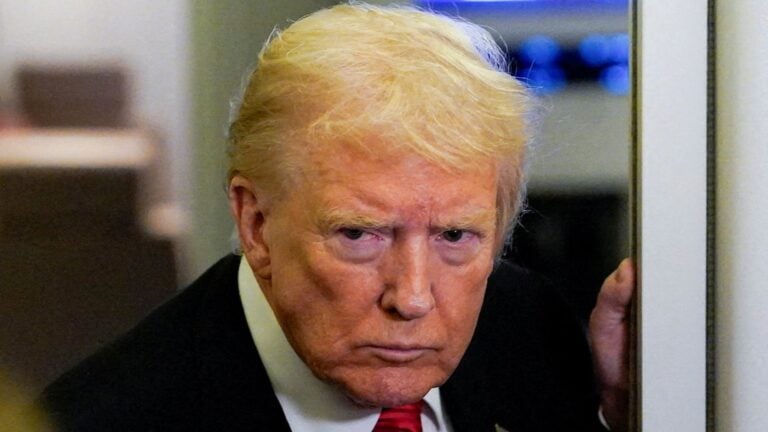
United States President Donald Trump has said that several countries may deploy naval warships alongside the United States to ensure that the strategically important Strait of Hormuz remains open, following reports that Iran is attempting to restrict access to the key maritime corridor.
In a statement posted on his social media platform, Truth Social, on Saturday, Trump indicated that countries whose economies rely heavily on the waterway could participate in a multinational effort aimed at securing safe passage through the strait.
“Many countries, especially those who are affected by Iran’s attempted closure of the Hormuz Strait, will be sending warships, in conjunction with the United States of America, to keep the Strait open and safe,” Trump wrote.
The Strait of Hormuz is regarded as one of the most vital shipping routes in the world. A large portion of global crude oil exports passes through the narrow channel daily, making it a crucial artery for international energy supply and trade. Any disruption to traffic in the strait could have far-reaching consequences for global oil prices, energy security, and the broader world economy.
Trump expressed hope that major global economies that depend on the route would contribute naval support to safeguard the waterway. Among the countries he mentioned were China, France, Japan, South Korea, and the United Kingdom.
“Hopefully China, France, Japan, South Korea, the UK and others that are affected by this artificial constraint will send ships to the area so that the Hormuz Strait will no longer be a threat,” he stated.
Despite the strong rhetoric, the US president did not provide details about which nations had formally agreed to join the naval mission. As of the time of the statement, there had also been no official confirmation from the governments of the countries mentioned regarding any planned deployment of warships to the region.
Trump further warned that although Iran’s military infrastructure had reportedly suffered significant setbacks, the country could still pose risks to vessels navigating the narrow waterway.
He noted that relatively small-scale attacks—such as the deployment of drones, sea mines, or short-range missiles—could still threaten commercial shipping passing through the corridor.
According to Trump, the United States would continue military operations in the region to deter any attempt to block the strait and to guarantee freedom of navigation.
“We have already destroyed 100 percent of Iran’s military capability, but it’s easy for them to send a drone or two, drop a mine, or launch a close-range missile somewhere along this waterway,” he said.
He added that American forces were prepared to take aggressive measures to neutralize any threats along the coastline bordering the strait.
“In the meantime, the United States will continue striking targets along the shoreline and intercepting Iranian boats and ships in the water. One way or another, we will soon ensure that the Hormuz Strait remains open, safe, and free,” Trump declared.
The comments come against the backdrop of rising tensions across the Middle East, where security concerns have intensified around key shipping routes in the Persian Gulf. The growing standoff involving Iran has raised fears among global markets and maritime operators about potential disruptions to international trade.
Earlier, on March 11, Iranian authorities reportedly warned that they could block oil shipments through the Strait of Hormuz, declaring that not “a single litre of oil” would be allowed to pass through the waterway for the benefit of the United States, Israel, and their allies if tensions continued to escalate.
Analysts note that any prolonged disruption in the strait could trigger sharp volatility in global energy markets, as many oil-producing nations in the Gulf rely on the narrow passage to export crude oil to the rest of the world.