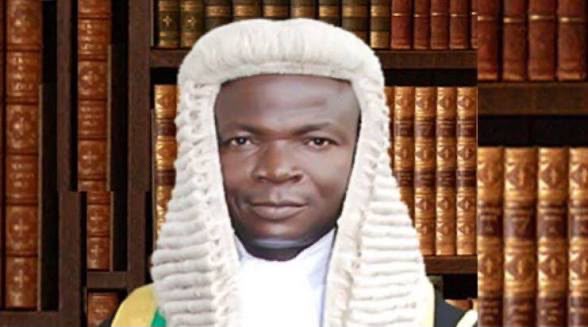
The Indigenous People of Biafra (IPOB) has directed its members worldwide to study and publicise what it described as the judicial fraud committed against its leader, Onyendu Mazi Nnamdi Kanu, insisting that Justice James Omotosho invented an uncharged terrorist act in his judgment to secure Kanu’s conviction.
The directive was contained in an internal memorandum issued by IPOB’s Spokesperson and Media and Publicity Secretary, Comrade Emma Powerful, addressed to all IPOB members worldwide.
The memorandum, titled “Mandatory Study: How Justice Omotosho Invented an Uncharged Terrorist Act to Convict Onyendu — Arm Yourselves With the Truth and Expose This Judicial Fraud,” instructed every IPOB member, from the highest leadership to the newest foot soldier, to read, study, memorise and master a legal analysis written by Barrister Onyedikachi Ifedi.
The legal document is titled “Omotosho’s Tenth Jurisdictional Failure — Fabricating an Unpleaded Terrorist Act at Judgment.”
According to IPOB, the document exposes fundamental legal defects in the conviction of Kanu and provides members with the necessary arguments to challenge what it described as propaganda surrounding the case.
The organisation maintained that the legal analysis should not be treated as a document meant exclusively for lawyers but as an everyday resource for every Biafran to understand the issues surrounding Kanu’s conviction.
IPOB stated that before the court delivered its judgment, Nigeria and Britain had used the BBC and other government-friendly media outlets to promote what it described as a false narrative against Kanu.
The organisation also accused the expelled Third Administration of the Directorate of State (DOS) of failing in its responsibility to educate the public and counter government narratives through Radio Biafra.
According to the memorandum, rather than using Radio Biafra to address the issues surrounding Kanu’s trial, the former administration allegedly occupied itself with activities serving the interests of its masters in Abuja and promoting unnecessary internal gossip.
IPOB maintained that this failure allowed the BBC, which it described as historically hostile to the Igbo race, to shape public perception of the case and create the impression that Kanu must have committed an offence deserving of a life sentence.
The organisation, however, insisted that a proper examination of the court proceedings and Justice Omotosho’s judgment exposed what it described as a fraudulent trial.
IPOB: You Cannot Charge A Man For One Offence And Convict Him For Another
Explaining the central argument of Barrister Ifedi’s legal analysis, IPOB emphasised what it described as one of the most fundamental principles of criminal justice: a defendant cannot be charged with one offence and convicted for another.
The organisation argued that a charge sheet legally binds the court and that a judge is expected to act as an impartial referee rather than a prosecutor.
According to IPOB, a judge cannot rewrite charges, manufacture missing evidence or introduce new criminal offences at the conclusion of a trial to rescue a failing prosecution.
The group maintained that this was precisely what Justice Omotosho did in his November 20, 2025 judgment in Charge No. FHC/ABJ/CR/383/2015.
IPOB identified four major issues which, according to the organisation, completely undermine the legal foundation of Kanu’s conviction.
- The Missing Terrorist Act In Counts 1 And 2
The first issue raised by IPOB concerns Counts 1 and 2 of the charge, which were brought under Section 1(2)(b) of the Terrorism Prevention (Amendment) Act 2013.
According to the organisation, the Nigerian Government accused Kanu of making broadcasts in furtherance of an act of terrorism.
However, IPOB questioned the specific terrorist act that Kanu allegedly furthered through the broadcasts.
The organisation directed members to examine pages 2 and 3 of the judgment, where the charge sheet was reproduced, insisting that it contained no identifiable terrorist attack.
IPOB highlighted three fundamental omissions:
- The charge sheet did not identify any specific terrorist attack.
- It did not name a single follower who allegedly carried out an attack.
- It did not identify any clear act of terrorism connected to the broadcasts.
The organisation argued that Kanu was accused of promoting or furthering an attack that was never named, described or documented in the charge sheet.
According to IPOB, the prosecution could not establish a terrorism conviction by referring to an unidentified terrorist act.
It maintained that the absence of a specific terrorist act in the charge sheet was a fundamental defect that should have brought the prosecution’s case to an end.
- A Broadcast Is Not A Bomb: IPOB Dissects Testimonies Of Five Masked Witnesses
The second issue concerns the testimonies of the five masked prosecution witnesses, whom IPOB said exposed serious weaknesses, contradictions and gaps in the prosecution’s case during cross-examination.
The witnesses were identified in the memorandum as PW1 (Mr TAA), PW2 (Mr BBB), PW3 (Mr CCC), PW4 (Mr DDD) and PW5 (Mr EEE).
IPOB provided detailed accounts of the evidence attributed to each witness.
PW1 (Mr TAA)
According to IPOB, PW1 admitted under cross-examination that he did not personally arrest or investigate anyone who committed a crime because of Kanu.
He also stated that he did not know whether Kanu had named any co-conspirator or whether anyone else was facing trial on a related charge.
The witness further admitted that he was unaware that several counts in the original 15-count charge had already been struck out.
IPOB also drew attention to PW1’s testimony during the trial-within-trial, where he allegedly claimed not to know Mr Brown Ekwoaba, the DSS officer who handled Kanu’s 2015 detention and questioning.
The organisation maintained that official DSS records established that Mr Ekwoaba was involved in the matter, making PW1’s response particularly significant.
PW2 (Mr BBB)
IPOB stated that PW2 testified under oath that he had never met Kanu before seeing him in court.
The organisation described the witness as an impostor who had never met Kanu and further maintained that he was not among the officers present during the July 17, 2021 video questioning at DSS Headquarters.
It also pointed out that the faces of the officers were not visible in the video.
According to the memorandum, PW2 admitted during cross-examination that he had never personally listened to Radio Biafra and relied instead on information provided by other people.
He also stated that he did not know whether Kanu had been held in solitary confinement before his statement was obtained or how long such detention lasted.
Furthermore, PW2 allegedly admitted that he did not know the contents of the charge against Kanu and could not establish whether anyone had been encouraged or provoked to commit a crime.
PW3 (Mr CCC)
IPOB stated that PW3 informed the court that his first contact with Kanu occurred on October 21, 2021, when he was instructed to interview him concerning Radio Biafra and IPOB.
The organisation questioned how the witness could testify about earlier events and broadcasts that took place before he became involved in the matter.
IPOB argued that such evidence was not based on his own direct and first-hand knowledge.
PW4 (Mr DDD)
According to IPOB, PW4 admitted under cross-examination that he did not sign any of the investigation reports.
He also stated that there were no records showing that the radio transmitter entered Nigeria through Lagos, apart from Kanu’s own statement.
The witness further acknowledged that he knew of no Fulani herdsman who had been prosecuted for attacking communities across the South-East.
PW5 (Mr EEE)
IPOB stated that PW5 admitted under cross-examination that the photographs appearing from page 669 of the report had no visible dates.
He also acknowledged that no part of the document was signed by him in his capacity as Secretary or by the Committee Chairman.
The organisation argued that these testimonies exposed serious weaknesses in the prosecution’s evidence, including unsigned investigation reports, undated photographs, contradictions and witnesses who lacked direct knowledge of important events.
IPOB maintained that a judge could not simply attach the label of terrorism to a radio broadcast to compensate for missing facts and weaknesses in the prosecution’s evidence.
It insisted that once the prosecution failed to identify the underlying terrorist act, the case could not legitimately proceed to a terrorism conviction on that basis.
- Justice Omotosho’s Courtroom Invention: Turning Mere Threats Into Terrorist Acts
The third and most significant issue identified by IPOB concerns Justice Omotosho’s interpretation of alleged threats of violence as completed terrorist acts.
The organisation accused the judge of crossing the boundaries of judicial authority by introducing a new criminal interpretation at the judgment stage.
IPOB specifically referred to page 96 of the November 20, 2025 judgment, where Justice Omotosho, while ruling on Count One, stated:
“These threats of violence are nothing but terrorist acts which was duly carried out by his followers as will be seen later in this judgment.”
The organisation also referred to page 102, where the judge reportedly stated that a sit-at-home order backed by threats amounted to nothing more than a terrorist act.
According to IPOB, these statements demonstrate that Justice Omotosho transformed alleged threats into completed terrorist acts through his own interpretation.
The organisation maintained that a threat is not the same thing as an actual terrorist attack and that the prosecution was required to identify the specific criminal act forming the basis of the charge.
IPOB further questioned the judge’s statement that the alleged terrorist acts were duly carried out by Kanu’s followers.
It argued that no follower was identified in the charge sheet and no specific attack was stated in Count One.
The group maintained that Justice Omotosho did not merely interpret the charge before the court but introduced a new criminal basis for conviction at the judgment stage.
IPOB further addressed Section 1(2)(a) of the Terrorism Prevention (Amendment) Act 2013, which contains provisions relating to threats.
According to the organisation, even if the prosecution relied on the word “threatens” under the provision, the law still required a specific act of terrorism satisfying the statutory definition.
The organisation explained that such an act must involve deliberate conduct, malice aforethought, the required terrorist purpose and one of the acts listed under the law.
It maintained that vague broadcast statements, general discussions about danger or a sit-at-home directive could not automatically satisfy all the statutory requirements for a terrorism offence.
IPOB also argued that the law distinguishes between a work stoppage or sit-at-home directive and terrorism unless all the necessary statutory elements are established.
The organisation insisted that neither the charge sheet nor a judge’s judgment could introduce a terrorist act that was never specifically pleaded.
It described the judge’s interpretation as a double legal error: first, transforming an alleged threat into a completed terrorist act and, secondly, claiming that unnamed followers had carried out the supposed acts.
- IPOB Addresses Other Counts And Exposes What It Calls The ‘Bomb’ Lie
The fourth issue concerns the other counts in the charge, which IPOB said government supporters might use to defend Kanu’s conviction when confronted with the arguments concerning Counts 1 and 2.
The organisation outlined the remaining allegations as follows:
- Count 3: Alleged membership and leadership of IPOB.
- Counts 4 and 5: Allegedly urging people through broadcasts to attack security personnel and their families.
- Count 6: Allegedly giving directions in a broadcast on how to make bombs.
- Count 7: Allegedly importing and possessing a radio transmitter.
IPOB maintained that none of these counts identified a completed terrorist attack.
The organisation particularly challenged the description of the alleged bomb in Count 6, arguing that the issue had been exaggerated.
It directed members to pages 124–125 of the judgment, where Justice Omotosho reportedly relied on Wikipedia.com and Encyclopaedia Britannica to define a Molotov cocktail.
IPOB pointed out that the judgment specifically recorded that Wikipedia was accessed at 1:00 a.m. on November 20, 2025, the same morning the judgment was delivered.
According to the organisation, the so-called bomb being discussed was a Molotov cocktail, which it described as a simple bottle filled with petrol.
IPOB compared such objects to those sometimes seen during street protests around the world, particularly when unarmed crowds confront harsh policing.
The organisation questioned the significance of describing a Molotov cocktail as a terrorist weapon without establishing that any such device had actually been manufactured, used or deployed in a terrorist attack.
It further argued that even if someone discussed making Molotov cocktails during a radio broadcast, that discussion did not automatically establish that a device was constructed, planted or used in an actual terrorist operation.
IPOB insisted that words spoken on radio could not be equated with a completed terrorist attack.
Why IPOB Says Barrister Ifedi’s Legal Analysis Is Important
Explaining why members must study the document, IPOB urged them not to limit their arguments to saying that Kanu was treated unfairly during the trial.
Instead, the organisation instructed members to rely on the court’s records, the specific judgment pages and the evidence presented by the prosecution’s own witnesses.
It stated that Barrister Onyedikachi Ifedi’s legal analysis identified the precise legal weaknesses behind what it described as a sham trial.
The organisation also referenced human rights activist and politician Omoyele Sowore, stating that even critics outside IPOB had described the trial as a sham.
IPOB maintained that the legal arguments contained in Ifedi’s document would enable members to respond effectively to government supporters, media commentators and other individuals discussing Kanu’s conviction.
The organisation also turned its attention to the British Government, insisting that it still had questions to answer concerning its role in Kanu’s forceful removal from Kenya.
It challenged the Nigerian Government to answer what it described as a straightforward question before the international community:
How can a man be convicted of furthering a terrorist act that is not written anywhere in the charge sheet, while mere threats are transformed into completed terrorist attacks in the judgment?
IPOB Issues Five Directives To Members Worldwide
In the concluding section of the memorandum, Comrade Emma Powerful issued specific instructions to IPOB members across the world, emphasising the importance of understanding and sharing Barrister Ifedi’s legal arguments.
The directives are as follows:
- READ THE DOCUMENT: Every IPOB member must read Barrister Onyedikachi Ifedi’s “Omotosho’s Tenth Jurisdictional Failure” from beginning to end.
- REMEMBER THE CORE LEGAL FLAW: Members must understand that Counts 1 and 2 accused Kanu of furthering a terrorist act without identifying any specific terrorist act. The organisation specifically directed members to remember page 96 of the judgment, where Justice Omotosho allegedly turned threats into completed terrorist acts.
- KEEP THE ISSUES SEPARATE: Members must distinguish between a radio broadcast, a mere threat, discussions about protest-style petrol bottles or Molotov cocktails, and an actual terrorist attack identified in a criminal charge.
- USE THE COURT RECORDS: Members must use the relevant judgment pages and the testimonies of PW1 to PW5 during discussions, broadcasts, meetings and media appearances to respond to arguments surrounding Kanu’s conviction.
- SHARE THE DOCUMENT WIDELY: Members must circulate Barrister Ifedi’s legal analysis across every available group and platform to ensure that Biafrans understand the issues surrounding the conviction.
The memorandum concluded with a strong declaration:
“NO TERRORIST ACT IN THE CHARGE. NO RIGHT TO TURN THREATS INTO ATTACKS IN THE JUDGMENT.”
Comrade Emma Powerful further urged IPOB members to understand the details of the case, insisting that people who know the facts cannot easily be deceived or intimidated by what the organisation described as courtroom tricks.
The statement was signed by Comrade Emma Powerful, Spokesperson and Media and Publicity Secretary of the Indigenous People of Biafra (IPOB).