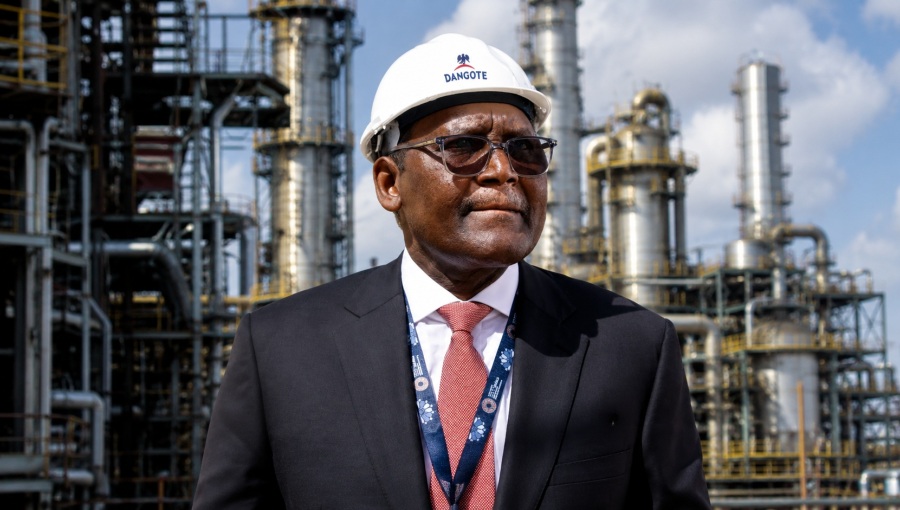
With a week left before the Dangote Refinery IPO closes, investors are deciding whether N525 is too much to pay for the shares.
The offer opened on September 14 and closes on October 13. It comprises 4.1 billion shares at N525 each, raising about N2.15 trillion, or roughly $1.6 billion. At that price, the refinery is valued at about $49 billion.
Demand appears strong. Dangote Group has approached the Securities and Exchange Commission (SEC) about increasing the number of shares available if demand warrants it.
On October 6, David Bird, chief executive of Dangote Petroleum Refinery, said the company is targeting as many as 10 million retail investors, more than twice the 4.5 million retail subscribers who participated in Saudi Aramco’s 2019 IPO.
A large retail turnout would demonstrate the scale of interest in the offer. It would not, by itself, establish whether N525 is a good price.
Institutional investors participated in a $2.5 billion private placement in July at a valuation of about $40 billion. The IPO now values the refinery at roughly $49 billion. That represents a valuation increase of more than 20 per cent in a matter of weeks.
Dangote Refinery reported about $1.82 billion in after-tax profit in the first half of 2026, compared with a $476 million loss for the whole of 2025. The refinery has reached full production capacity and is supplying petrol, diesel and aviation fuel to Nigeria and export markets.
Those results provide a basis for the higher valuation being sought. But refining is a cyclical business. Profits rise when fuel supplies tighten and refining margins widen. They can fall when supplies recover and margins contract.
Dangote has benefited from an unusually favourable market. Disruptions associated with the war involving Iran have tightened fuel supplies and supported refining margins. The refinery has supplied substantial quantities of jet fuel to Europe during the disruption. Reuters has reported that the refinery benefited from supply disruptions linked to the Iran war, while EIA data show Nigerian petroleum-product exports to Europe reached an average 130,000 barrels per day in the second quarter of 2026.
The first-half result demonstrates what Dangote Refinery can earn in strong market conditions. It does not establish that $1.82 billion is a sustainable six-month profit.
If refining margins fall towards more normal levels, profits could fall with them. Investors buying at N525 therefore need to believe either that current earnings can be sustained or that future growth will compensate for any decline.
At about 700,000 barrels per day, it is the world’s largest single-train refinery. It has access to Nigeria’s large domestic market and increasingly to other African markets. Nigeria spent decades exporting crude while importing much of the petrol, diesel and aviation fuel it consumed. Dangote has changed that equation by refining crude locally and exporting surplus products. EIA data show that petroleum-product exports from Nigeria averaged 350,000 barrels per day in the second quarter of 2026, while seaborne imports fell to less than 130,000 barrels per day.
But the scale of the refinery also creates a dependence on export markets.
Domestic demand alone cannot absorb 1.4 million barrels per day of refined products. That is the capacity Dangote intends to reach by 2029/2030. The economics of the expansion will therefore depend heavily on the company’s ability to sell large volumes outside Nigeria at profitable prices.
Access to those markets does not guarantee margins. Nor does access to Nigerian crude.
The refinery has already sourced crude from countries outside Nigeria. That gives it flexibility, but it also shows that the investment case depends on maintaining reliable access to sufficient crude at competitive prices. The company’s prospectus identifies adequate and timely crude supply as an operational risk and says the refinery currently relies on both domestic and international sources.
Then there is the cost of expansion.
Dangote expects to spend about $14.3 billion to double refining capacity to 1.4 million barrels per day. Investors buying the IPO are therefore buying into a company that intends to commit another $14.3 billion to expansion after completing a project that cost about $20 billion.
The return on that additional capital will depend on the refining market when the new capacity comes on stream.
Dangote Refinery is an extraordinary industrial achievement. It does not follow that it is an extraordinary investment at any price. At N525, investors are being asked to decide how much of the refinery’s future earnings should be paid for today.
The small free float adds another consideration.
The IPO represents only about 3.3 per cent of the enlarged share capital. Millions of investors could therefore become shareholders while the overwhelming majority of the company remains closely held.
A small free float can support a share price when demand is strong because relatively few shares are available for trading. It can also produce sharp movements when sentiment changes.
The current demand figures should therefore be read as evidence of interest in the shares, not as evidence that the $49 billion valuation is fair.
The minimum subscription is only 10 shares, or N5,250. That low entry point makes participation possible for a very large number of people.
But affordability is not value.
Dangote has said the N525 share could eventually reach N10,000.
Such an increase would require a dramatic rise in the earnings capable of supporting the company’s valuation, a much higher valuation multiple, or both. It is a projection by the founder, not an analyst target or a guaranteed return.
The business must sustain production and crude supply while earning enough from domestic and export markets to justify the capital being committed to expansion. Refining margins could fall, crude costs could rise and additional refining capacity could intensify competition.
The longer-term transition away from fossil fuels is another risk, although Nigeria and much of Africa are likely to retain substantial petroleum demand for years because of population growth, industrialisation and relatively low vehicle ownership.
For investors, the $40 billion private placement is the clearest recent valuation benchmark. The IPO asks them to accept a valuation roughly 22.5 per cent higher only weeks later.
For that higher valuation to hold, the refinery will need to turn its scale and current earnings into sustainable cash generation while earning attractive returns on the additional capital required for expansion.
The refinery is coming to market after a period of unusually favourable refining margins. Reuters’ Breakingviews described the IPO price as effectively assuming that tight diesel and jet fuel markets will remain favourable.
If margins normalise before the expansion begins to generate returns, the valuation could come under pressure.
If Dangote maintains strong earnings, expands profitably and converts its scale into durable cash flow, N525 will become easier to defend.
Dangote Refinery is a remarkable business. The investment decision is whether its future earnings and cash generation justify a $49 billion valuation today.