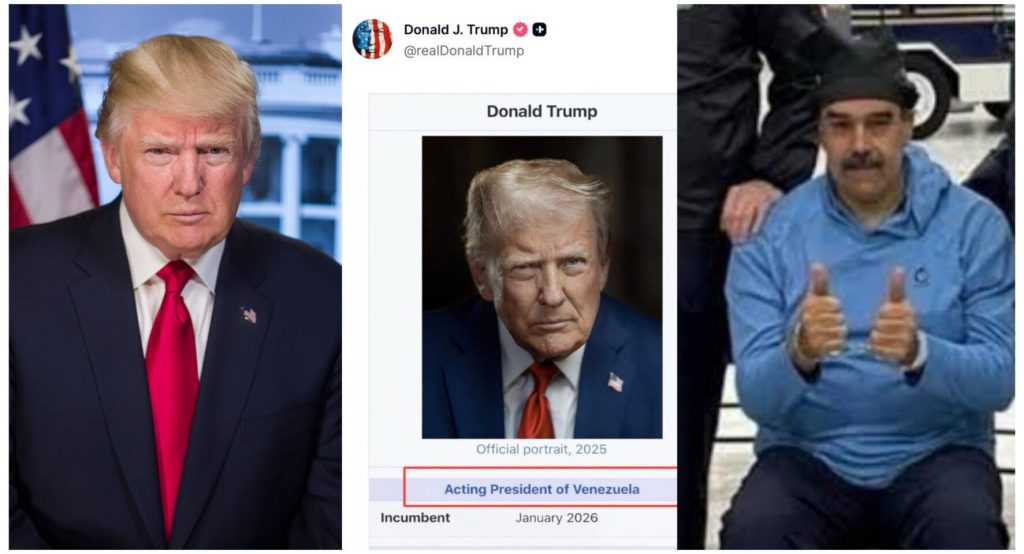
U.S. President Donald Trump has sparked widespread debate and international scrutiny after sharing a provocative image on his social media platform, Truth Social, portraying himself as the “Acting President of Venezuela.” The digitally altered image, styled like a Wikipedia entry, lists him with that title as of January 2026 a move that has raised eyebrows among diplomats and analysts around the world.
Trump’s post came amid heightened U.S. involvement in Venezuelan affairs following a dramatic military operation in early January, in which Venezuelan President Nicolás Maduro and his wife, Cilia Flores, were captured by U.S. forces and transported to New York to face legal charges. U.S. officials described the intervention as part of a law-enforcement action targeting long-standing allegations of narcotics trafficking and related offenses.
The social media post drew strong reactions internationally, with many commentators describing it as a symbolic gesture rather than a legitimate claim to Venezuelan leadership. Critics argued the image reflects the increasingly blurred lines between political messaging, diplomatic action, and constitutional norms particularly as Venezuela’s own constitutional succession process designated Vice President Delcy Rodríguez as interim president following Maduro’s removal.
National Emergency Order on Venezuelan Oil Funds
Days before the viral image, President Trump signed an executive order declaring a national emergency to safeguard Venezuelan oil revenues held in U.S. Treasury accounts. According to the White House, this measure is aimed at protecting U.S. foreign policy and national security interests by preventing these funds deposited as Foreign Government Deposit Funds from being subject to legal claims or seizure.
The order blocks any transfer or dealings involving these oil revenues without specific authorization and maintains that the assets remain Venezuela’s sovereign property, held in U.S. custody for diplomatic and governmental purposes.
This directive reinforces Washington’s strategic leverage over Venezuela’s vast energy resources, a key point of contention as the U.S. government signals possible changes to sanctions and engages with energy executives about investments in the country’s oil sector.
Security Advisories and Diplomatic Strains
Amid the escalating situation, the U.S. Embassy has reiterated stern travel warnings for American citizens in Venezuela. In an alert issued on January 10, 2026, U.S. nationals were advised not to travel to Venezuela and to leave immediately if already in the country, citing fragile security conditions. The embassy also reminded Americans that all U.S. diplomatic personnel were withdrawn from Caracas in 2019 and consular services remain suspended.
International reactions have been mixed, with some governments and United Nations officials criticizing the U.S. operation as a violation of Venezuelan sovereignty and international law. Venezuela’s allies, including Russia and China, have condemned the actions at the U.N. Security Council, while allies of Washington emphasize the operation’s justification as combating narcotics trafficking and stabilizing regional security.